
.png)


Copper River Basin Temperature Monitoring
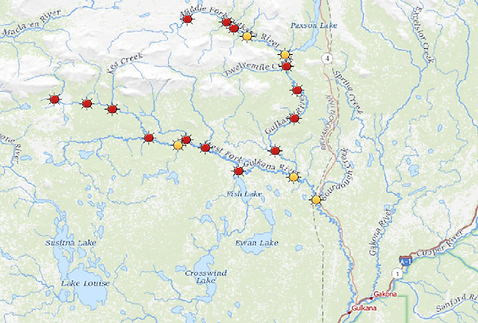
The Gulkana River Temperature Monitoring Network represents AITRC's commitment to long-term stewardship of one of the Copper River Basin's most important salmon producing watersheds. In 2025, AITRC assumed responsibility for this long-standing monitoring program from the U.S. Fish and Wildlife Service, ensuring that valuable temperature data continue to be collected. Today, AITRC maintains 122 remote temperature loggers throughout the Middle and West Forks of the Gulkana River, with field crews rafting the watershed each summer to service equipment and retrieve year-round temperature data. This information provides critical insight into changing stream conditions, supports salmon conservation and habitat restoration, and helps guide science-based management across the Ahtna Territory.


Funded by the National Oceanic and Atmospheric Administration In partnership with the U.S. Fish and Wildlife Service on the Gulkana River Temperature Network. Basin-wide monitoring is conducted in collaboration with the Copper River Watershed Project
Understanding Changing Waters.
Water is one of the most important resources in the Ahtna Territory, and its temperature plays a critical role in the health of rivers, fish, and the ecosystems that surround them. While stream temperature may seem like a simple measurement, it influences nearly every aspect of a river's ecology.
Salmon and other native fish are cold-water species that have evolved to survive within a relatively narrow range of water temperatures. Even small changes in temperature can affect how quickly eggs develop, how fast juvenile fish grow, when adults migrate upstream to spawn, how much oxygen is available in the water, and how vulnerable fish become to disease or environmental stress. As Alaska's climate continues to change, understanding how glacial and precipitation-driven rivers respond has become increasingly important for protecting salmon and the people who depend on them.
To better understand these changes, AITRC maintains long-term stream temperature monitoring stations throughout the Copper River Basin. By collecting temperature data year after year, AITRC is building one of the most valuable records of changing water conditions in the Ahtna Territory. These data support fisheries research, habitat restoration, climate adaptation, and resource management while helping ensure that future generations continue to have healthy salmon populations and thriving rivers.
Monitoring Across the Copper River Basin.
AITRC is a partner in Alaska's statewide stream temperature monitoring network, collecting year-round water temperature data throughout the Copper River Basin to help identify suitable spawning and rearing habitat, thermal barriers to migration, and better understand how changing environmental conditions affect the resource.
A major focus of this work is the Gulkana River, one of the most important salmon-producing tributaries of the Copper River. Every year, thousands of Chinook and sockeye salmon return to the Gulkana watershed to spawn, while juvenile salmon use it as important rearing habitat before migrating to the ocean.
Unlike many rivers in the Copper River Basin that are fed by glacial meltwater, the Gulkana River is primarily supplied by precipitation, groundwater, wetlands, and seasonal snowmelt. Because it lacks the cooling influence of glaciers, the watershed responds more quickly to changes in air temperature, making it especially sensitive to the effects of climate change. This also makes it an ideal location for long-term monitoring, as changes observed in the Gulkana River can provide an early indication of how warming temperatures may influence salmon habitat throughout Interior Alaska.
To monitor these changes, AITRC assumed responsibility for maintaining 122 remote temperature loggers throughout the Middle Fork and West Fork Gulkana River after the U.S. Fish and Wildlife Service transferred leadership of the project to AITRC. The U.S. Fish and Wildlife Service continues to support the project through potential equipment assistance and efforts to identify additional funding opportunities. Each summer, field crews spend approximately 10 days rafting through the watershed to retrieve temperature data, inspect and service equipment, and prepare each monitoring station for another year of continuous data collection



How Temperature Loggers Work
Although the monitoring equipment is relatively small, it is designed to withstand years of exposure to flowing water, ice, flooding, and changing seasonal conditions.
Each monitoring station consists of a waterproof electronic temperature logger housed inside a protective section of PVC pipe.
The PVC housing serves several important purposes, including shielding the temperature sensor from direct sunlight to prevent solar heating from artificially increasing recorded temperatures. Without this protection, the logger could measure temperatures that are warmer than the surrounding water, reducing the accuracy of the dataset.
The PVC housing is anchored to a tree or duckbill anchor on shore and secondarily attached to a weighted sandbag in the stream to maintain depth and location of the temperature logger. Keeping the logger in a stable location is important because water temperature can vary between shallow edges, deeper pools, and faster-moving channels. Temperature loggers which are strategically deployed in pairs near tributary confluences (cold or warm water inputs) are located where cross-sectional transect temperatures remain uniform to ensure reliable data. Anchoring the logger near the bottom of the stream allows measurements to be collected from a consistent location throughout the monitoring period.
Because the loggers remain in place year-round, they continue collecting data through spring runoff, summer warming, autumn cooling, and winter ice conditions. This continuous record provides a complete picture of seasonal temperature changes rather than just a snapshot collected during summer fieldwork.
Each summer, technicians visit every monitoring site to download data, inspect equipment, and replace or service loggers as needed before redeploying them for another year of monitoring.


AKTEMP
All data from both the 2023/2024 and 2024/2025 monitoring periods and updated site locations are now publicly available on Alaska Water Temperature Database To view all loggers in Alaska, click "BACK TO EXPLORER" or visit https://aktemp.uaa.alaska.edu/
Project Leads: Dan Gorze | Questions on this project?