
.png)


Klutina Sonar
The Klutina River Sonar pilot project monitored salmon returning to one of the Copper River Basin’s most important salmon-producing tributaries in 2022 and 2023. AITRC worked with the Native Village of Eyak to use sonar technology to estimate salmon passage, document run timing, and strengthen tributary-specific information for sockeye and Chinook salmon.
The feasibility project was successful and if funded in the future, would help fill an important information gap within the Copper River watershed. By developing reliable estimates of salmon entering the Klutina River, this work supports long-term population monitoring, subsistence stewardship, fisheries management, and greater Tribal involvement in the collection and interpretation of fisheries data.
Monitoring Salmon in One of the Copper River’s Most Important Tributaries?
The Klutina River watershed supports a major portion of the salmon returning to the Copper River system, including salmon harvested in commercial fisheries. Previous radio-telemetry studies suggest that approximately 50% of Copper River sockeye salmon escapement and 12% of Chinook salmon escapement may spawn within the Klutina River watershed. Because of its importance to salmon production and subsistence fisheries, understanding how many salmon return to the Klutina each year is an important part of improving fisheries management..
The Klutina River Sonar Pilot Project was developed to evaluate whether Adaptive Resolution Imaging Sonar (ARIS) technology could be used to monitor salmon passage, determine run timing, and estimate salmon escapement within the Klutina River. The project also provided an opportunity to strengthen Tribal fisheries research capacity and improve tributary-specific information available to fisheries managers and communities.
Why Klutina?
Despite the importance of the Klutina River to Copper River salmon production, detailed annual abundance information has not been collected outside of this project. Seperate aerial surveys comparing year to year salmon abundance in Manker and St. Anne Creeks which are tributaries to Klutina Lake have occurred but there is a need for actual escapement data in this productive drainage.
This information gap is especially important in a now long-term period of basin-wide low Chinook salmon abundance and increasingly variable Copper River sockeye salmon returns. Greater variability in salmon returns can reduce harvest opportunities and create uncertainty for fisheries throughout the region, including Alaska Native Peoples and rural residents who have longstanding cultural and subsistence relationships with Copper River salmon.
Collecting tributary-specific information on salmon abundance and run timing can help managers better understand how salmon are distributed throughout the Copper River watershed and provide additional information for pre-season, in-season, and post-season fisheries management.


How Sonar Monitoring Works?
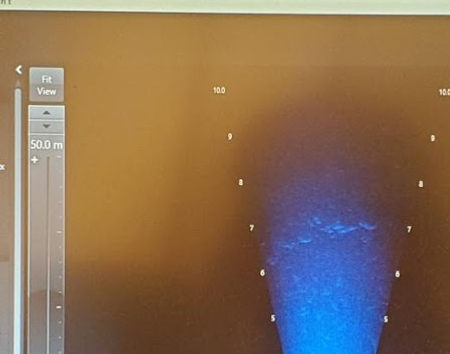
Sonar is an underwater monitoring system that uses sound waves to detect and record fish moving through a river. By creating detailed images of salmon as they migrate upstream, sonar allows biologists to count fish and track movement without handling or disturbing them. When fish pass through the sonar beam, their movement appears in the recorded sonar imagery, allowing technicians to identify and count fish without physically capturing them.
For the Klutina River project, the proposed monitoring system uses multi-beam sonar units positioned on both riverbanks to monitor fish passage across the river.
Researchers evaluate potential sonar locations based on several factors, including:
-
River depth and underwater shape, or bathymetry
-
Water flow
-
Salmon migration routes
-
Riverbank and riverbed stability
-
Access and safety
-
Recreational activity
-
Operational costs
-
Potential obstructions that could interfere with sonar coverage
An ideal sonar site provides clear coverage from bank to bank and allows migrating fish to pass through the area monitored by the sonar. Because the Klutina River carries glacial silt and has low visibility, sonar is one of the most reliable tools for monitoring salmon in this system.
Counting Salmon.
During sonar operations, recorded imagery can be reviewed to determine how many fish are moving upstream and downstream.
The project design calls for technicians to review portions of each recorded hour and use those observations to estimate hourly and daily fish passage. These daily estimates can then be combined to produce weekly and seasonal estimates of salmon moving through the Klutina River.
Monitoring is intended to cover the primary sockeye salmon migration period, generally beginning around early June and continuing into August, depending on salmon passage.


Supporting Better Salmon Management!
Information collected through the Klutina River Sonar Project can help provide a clearer picture of salmon returning specifically to the Klutina River rather than relying only on Copper River system-wide estimates.
Understanding tributary-specific abundance and run timing can help fisheries managers:
-
Track changes in salmon returns over time.
-
Better understand the contribution of Klutina River salmon to the Copper River system.
-
Improve salmon escapement estimates.
-
Support management decisions affecting subsistence and other fisheries.
-
Build a stronger long-term understanding of salmon populations within the Copper River Basin.
Building Long-Term Salmon Knowledge.
The Klutina River Sonar Project brings together AITRC and the Native Village of Eyak (NVE) to strengthen Tribal-led fisheries research in the Copper River Basin. Through this partnership, AITRC has gained hands-on experience with sonar technology, salmon monitoring, data collection, and the development of long-term fisheries research programs.
Beyond a single monitoring project, this work helps build the local knowledge, skills, and capacity needed to better understand Copper River salmon over time. By improving information about salmon abundance and run timing in individual tributaries like the Klutina River, Tribal organizations, communities, and fisheries managers can make more informed decisions about the salmon populations that are so important for subsistence, culture, and future generations.
Project Leads: Dan Gorze | Questions on this project?