
.png)


Wolf Research: Range, Distribution, and Seasonal Diet
AITRC, in partnership with the Native Village of Tazlina and generous contributions from Ahtna Inc., is leading the first known tribally managed wolf capture and collaring project in Alaska! Funded through the U.S. Fish and Wildlife Service Tribal Wildlife Grant program, this research addresses critical data gaps related to wolf range, distribution, and seasonal diet within Game Management Unit (GMU) 11.

Funded through the U.S. Fish and Wildlife Service Tribal Wildlife Grants Program and Ahtna Inc., in partnership with the Native Village of Tazlina
Background.
Wolves are an important part of the ecosystems of Ahtna Territory and have complex relationships with moose, caribou, Dall sheep, and other wildlife that Tribal citizens depend on for subsistence. Despite their ecological importance, there are significant gaps in current information about wolf movements, pack territories, seasonal diets, and health in eastern Ahtna Territory.
AITRC developed the Wolf Research Project to begin filling these gaps with locally focused, long-term data. By combining GPS tracking with biological samples and on-the-ground investigations, researchers can examine not only where wolves travel, but also how they use the landscape, what they eat throughout the year, and how wolf populations interact with other wildlife species.
In November 2024, AITRC successfully captured and GPS-collared nine wolves, establishing the foundation of the project. Additional capture efforts occurred in March 2025. The project operates under an approved Institutional Animal Care and Use Committee protocol through the National Park Service and research permits from the National Park Service, Alaska Department of Fish and Game, and Ahtna, Inc.

Where is GMU 11?
Game Management Units (GMUs) are geographic areas used by the Alaska Department of Fish and Game to organize wildlife management across Alaska. The state is divided into numbered GMUs, which help define areas for wildlife research, population monitoring, hunting regulations, and management decisions.
GMU 11 is located in eastern Southcentral Alaska and covers much of the Wrangell Mountains and surrounding Copper River Basin. It includes a large portion of Wrangell-St. Elias National Park and Preserve and extends through areas important to Ahtna communities and subsistence users.
AITRC's wolf research is primarily focused within GMU 11, while biological samples from trapper-harvested wolves are also collected from GMUs 12 and 13. Together, these areas allow researchers to better understand wolves across a broader portion of eastern Ahtna Territory.

Why Study Wolves in Ahtna Territory?
Information about wolf populations and ecology in this region is limited. Much of the previous research conducted in Alaska’s interior occurred decades ago and did not focus specifically on the eastern portion of Ahtna Territory.
Through this project, AITRC is working to establish baseline information on wolf distribution, pack dynamics, and diet that can support long-term stewardship and wildlife management decisions in the region.
Understanding how wolves move across the landscape and what prey species they rely on throughout the year provides important insight into broader ecosystem dynamics within Ahtna lands.
Capture & GPS Collar Deployment.
Wolves are located through aerial surveys and safely captured using established wildlife capture techniques. One to three wolves per pack are fitted with GPS collars, allowing researchers to track individual wolves and better understand how packs move and use the landscape throughout the year. Maintaining multiple collars within a pack also helps reduce data loss if a wolf disperses, dies, or a collar stops transmitting.
Each collared wolf can be identified by its individual collar color and identification number. These colors make it easier to distinguish between wolves when viewing GPS movement maps, field observations, and trail camera images. Tracking multiple individuals can also help researchers see how wolves within the same pack move together or separately over time.
GPS collars provide valuable information about:
-
Seasonal movement patterns
-
Pack territories and areas of overlap
-
Travel corridors and habitat use
-
Dispersal of individual wolves
-
Potential kill and feeding sites
-
Rendezvous and denning areas
When GPS data show a wolf spending significant time in one location, researchers can identify the area as a location cluster and investigate it in the field. Connecting GPS movement data with evidence found on the ground helps researchers understand not only where wolves are traveling, but what they are doing in different parts of their territory.


Field Monitoring and Site Investigations.
During the 2024–2026 field season, AITRC's wildlife technicians conducted systematic site investigations at clustered GPS locations. These investigations focused on identifying kill sites, rendezvous areas, and denning locations.
Field teams travel by foot, snowmachine, ATV, or aircraft depending on seasonal conditions and access. At investigation sites, crews may:
-
Identify and document prey remains
-
Collect wolf scat
-
Collect hair or other biological material
-
Record tracks and other signs
-
Document habitat conditions
-
Deploy trail cameras
-
Determine how wolves were using the site
These investigations help connect movement data with what is actually occurring on the ground, providing insight into prey species, hunting behavior, and pack activity.
Understanding Wolf Diet.
One of the project's major goals is understanding what wolves eat and how their diets change throughout the year.
Prey remains documented during GPS cluster investigations provide direct evidence of feeding activity, while scat, tissue, hair, and whisker samples can provide additional information that may not be visible through field observations alone.
AITRC is incorporating laboratory techniques including stable isotope analysis and fecal metabarcoding to investigate wolf diets. Stable isotope analysis can provide information about dietary patterns over time, while metabarcoding can identify prey DNA contained within scat samples.
Preliminary stable isotope work has already shown differences along segmented wolf whiskers, suggesting changes in diet over time. Additional research is being conducted to better understand wolf whisker growth rates so those changes can be associated with specific time periods.
Together, these methods can provide a more complete understanding of the role different prey species play in wolf diets across seasons.

AITRC also works with local trappers to collect supplemental biological samples in GMU 11, 12, and 13!
Together, these biological samples provide a detailed picture of wolf health and disease presence, seasonal and long-term diet patterns, environmental conditions, and overall ecosystem stability. By combining field observations with laboratory analysis, AITRC builds reliable, science-based information to support wildlife stewardship across Ahtna’s Eastern Territory.
Biological Sample Collection.
What do we collect?
Click the " " to learn more about each sample
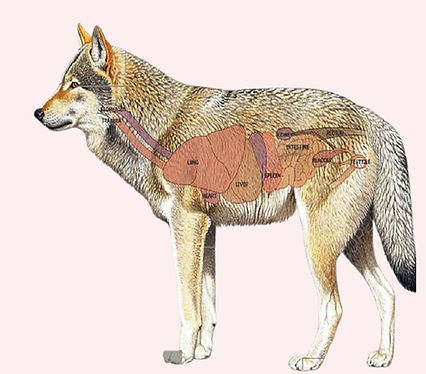
AITRC works with several university partners to analyze samples collected through the Wolf Research Project. The University of Alaska Fairbanks and University of Calgary analyze wolf hair for mercury to evaluate contaminant exposure, while the University of Alberta conducts stable isotope analysis of hair, whiskers, and prey species to better understand seasonal changes in wolf diet. Oregon State University conducts fecal metabarcoding and genomic analyses using wolf scat to identify prey species and provide additional genetic information about wolves.


In 2025, our wildlife team traveled to the University of Alaska Fairbanks to conduct a necropsy on a GPS-collared wolf after its collar transmitted a mortality signal indicating no movement. Examination of the carcass determined the wolf had been killed by a brown bear, based on field investigations and trauma patterns.

Wildlife Biologist Sterling Spilinek accompanied a local pilot during an aerial flight to investigate wolf movements in the area.
_JPG.jpg)
Trevor Alexander and Ethan Vollema, 2025-26 wildlife technicians, conducting samples from trapper-harvested wolves.

Collared wolf caught on our trail cameras!
Project Leads: Sterling Spilinek | Questions on this project?